

 0
0
 0
0
This guide covers everything you need to know about forex trading guide for beginners.
Module 1: Introduction to the Forex Market: Understanding Forex Trading Guide For Beginners
When exploring forex trading guide for beginners, it is important to approach the subject with patience and a willingness to learn. Many successful traders emphasize that understanding forex trading guide for beginners thoroughly before making decisions is the foundation of long-term growth in the forex market.
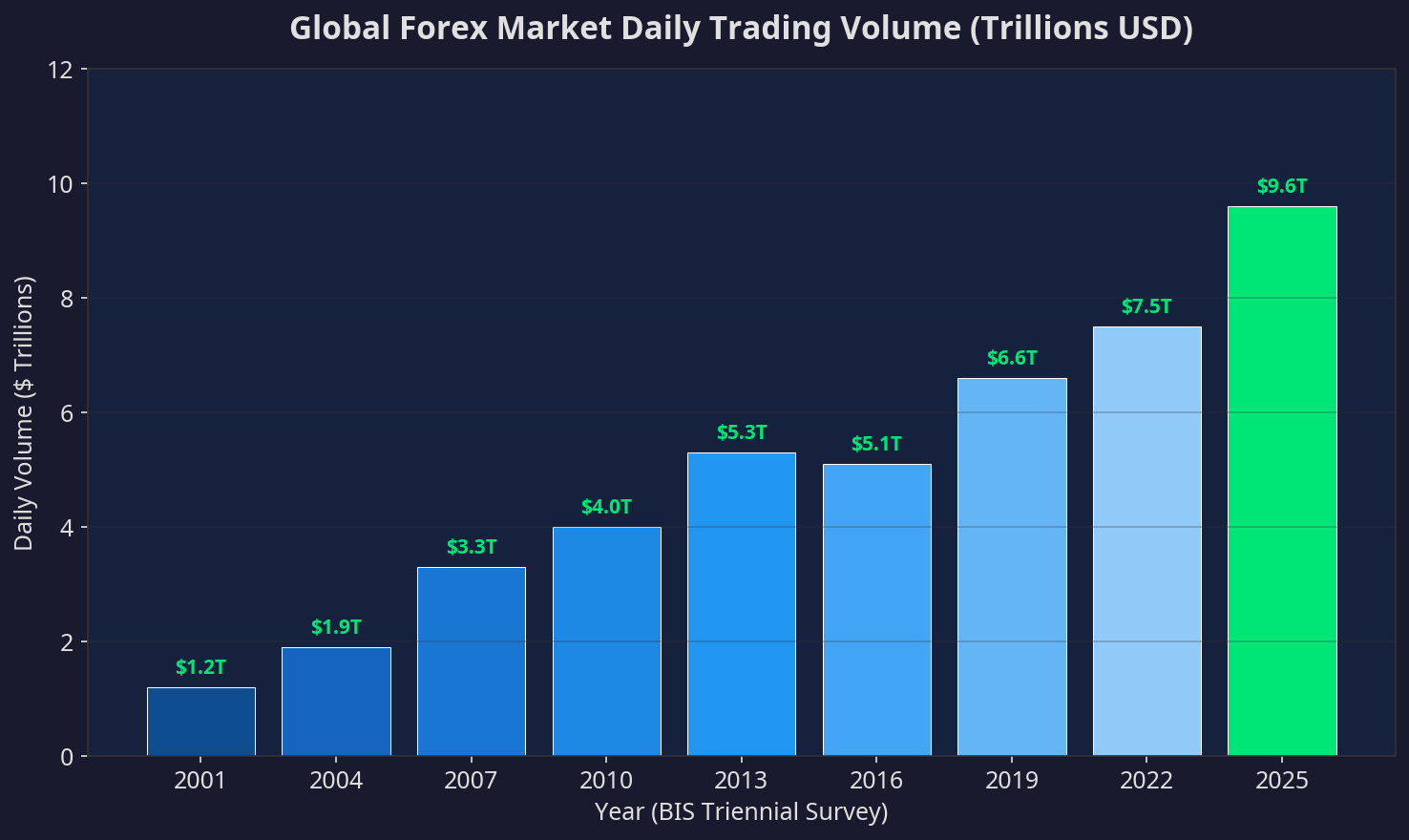
Welcome to your foundational course in Forex trading. The Foreign Exchange (Forex) market is the largest and most liquid financial market globally, with a daily trading volume now exceeding $9.6 trillion as of April 2025. This module will introduce the fundamental concepts of Forex trading, providing the necessary knowledge to begin your educational journey in this field.
1.1 Defining Forex Trading
Forex trading is the decentralized global market where the world’s currencies are traded. It involves the buying of one currency and the simultaneous selling of another. Currencies are always traded in pairs, such as the EUR/USD (Euro/US Dollar). The primary objective is to profit from the anticipated change in the relative value of these currencies.
1.2 Market Participants
The Forex market is a complex ecosystem with various participants, each with different motivations:
- Central Banks: National banks like the U.S. Federal Reserve and the European Central Bank, which participate to manage their country’s currency, foreign exchange reserves, and interest rates.
- Institutional Investors: Large entities such as hedge funds, investment managers, and multinational corporations that trade for speculative purposes or to hedge against currency risk.
- Retail Traders: Individual traders who speculate on currency movements through online brokerage platforms.
1.3 Core Terminology for the Novice Trader
To engage with the Forex market, a clear understanding of its terminology is essential:
| Term | Definition |
|---|---|
| Base/Quote Currency | In a pair like EUR/USD, the first currency (EUR) is the base, and the second (USD) is the quote. |
| Pip (Percentage in Point) | The smallest unit of price movement in an exchange rate. For most currency pairs, one pip is equivalent to a 0.0001 change. |
| Leverage | A tool that allows traders to control a large position with a smaller amount of capital. A 50:1 leverage means you can control a $50,000 position with $1,000. |
| Spread | The difference between the ‘ask’ (buy) price and the ‘bid’ (sell) price of a currency pair. |
| Lot Size | A standardized unit of currency. A standard lot is 100,000 units, a mini lot is 10,000, a micro lot is 1,000, and a nano lot is 100. |
| Margin | The amount of capital required in your account to open and maintain a leveraged position. |
Module 2: Understanding the Forex Market Structure
2.1 Market Types
The Forex market operates through several market types:
- Spot Market: The largest market where currencies are bought and sold for immediate delivery (settled in two days). This is the primary market for retail traders.
- Forwards Market: Private, over-the-counter (OTC) contracts to buy or sell a currency at a predetermined price on a future date.
- Futures Market: Standardized contracts traded on exchanges like the Chicago Mercantile Exchange (CME) for a specific currency amount and future settlement date.
2.2 Chart Types
Visualizing price movements is critical. Traders primarily use three types of charts:
- Line Charts: The simplest form, connecting closing prices over a period to show the general trend.
- Bar Charts: Provide more detail, showing the open, high, low, and close (OHLC) prices for each period.
- Candlestick Charts: The most popular type, offering a visually intuitive representation of OHLC data and forming patterns that traders use for analysis.
Module 3: Your First Steps in Forex Trading
This module provides a structured, step-by-step process for individuals new to Forex trading.
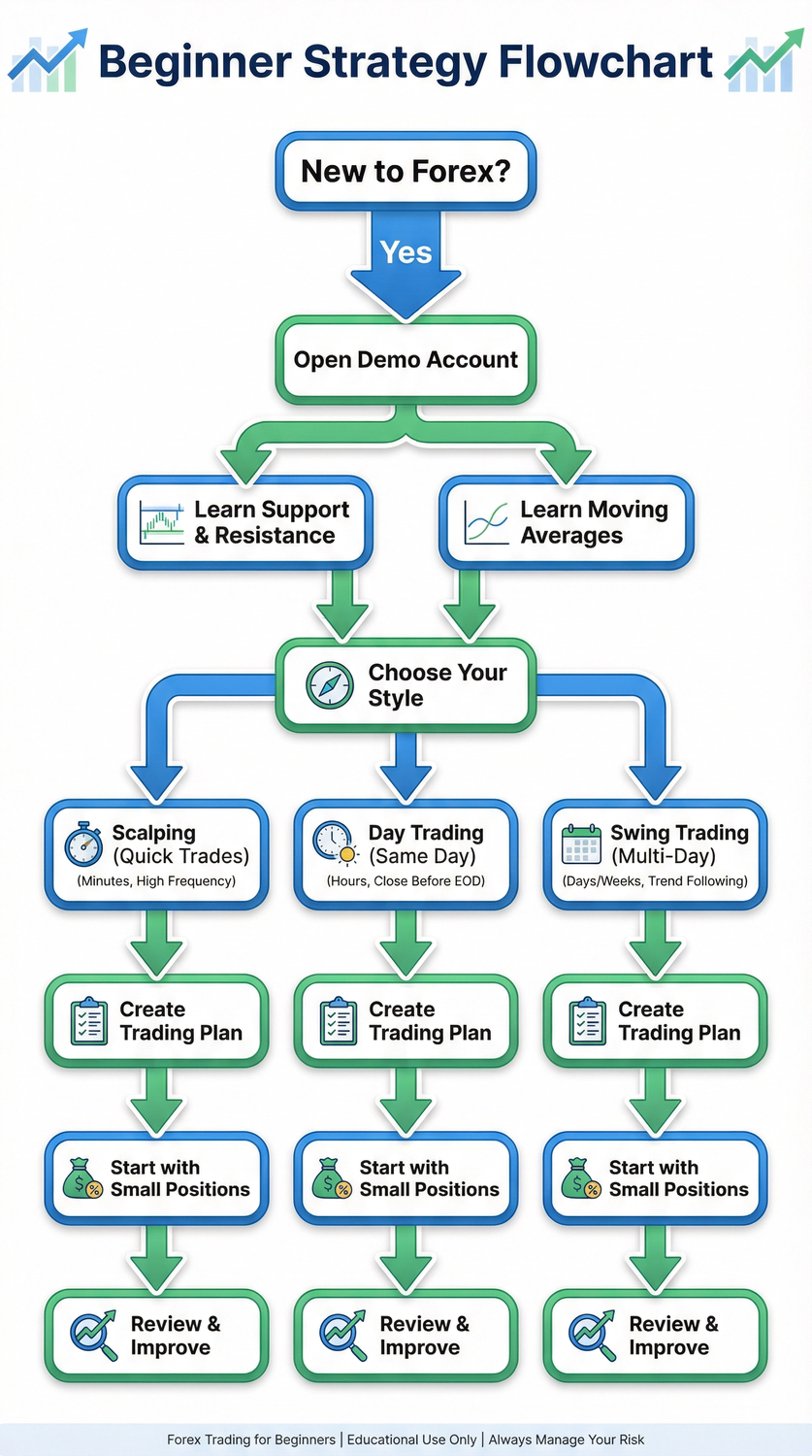
3.1 Step 1: Selecting a Regulated Broker
The choice of a broker is a critical decision. A reputable broker should be regulated by a recognized financial authority (like the CFTC in the U.S.), offer a user-friendly trading platform, provide competitive spreads, and have responsive customer support.
3.2 Step 2: Practicing with a Demonstration (Demo) Account
Before committing real capital, it is imperative to practice with a demo account. This simulated trading environment allows you to familiarize yourself with the trading platform and test strategies without any financial risk.
3.3 Step 3: Learning Foundational Trading Techniques
Begin with fundamental analytical techniques:
- Support and Resistance: These are price levels at which the market has historically shown a tendency to reverse or consolidate.
- Moving Averages: These are indicators that smooth out price data to create a single flowing line, making it easier to identify the direction of the trend.
Module 4: Foundational Trading Strategies
Once you have mastered the basics, you can explore various trading strategies. The optimal strategy will align with your individual risk tolerance and time commitment.
| Strategy | Description | Time Commitment |
|---|---|---|
| Scalping | Executing a high volume of trades to capture very small price movements (pips). | High |
| Day Trading | Opening and closing positions within the same trading day. | Medium to High |
| Swing Trading | Holding positions for several days to profit from larger price swings. | Low to Medium |
| Position Trading | Holding positions for months or even years, based on long-term fundamental analysis. | Low |
Module 5: Risk Management Principles
A disciplined approach to risk management is what separates successful traders from the rest.
5.1 The Risk-Reward Ratio
This ratio helps you assess the potential profit of a trade relative to its potential loss. A common minimum ratio is 1:2, meaning you aim to make at least twice as much as you are willing to risk on a single trade. This allows for profitability even if you only win a minority of your trades.
5.2 Stop-Loss Orders
A stop-loss order is an essential tool that automatically closes your trade at a predetermined price to limit your losses. It is a critical defense against significant market moves against your position.
5.3 The Dangers of Over-Leveraging
While leverage can amplify gains, it equally magnifies losses. A small market movement against a highly leveraged position can result in the complete loss of your trading capital. It is crucial to use leverage judiciously and understand its risks fully.
Module 6: Conclusion and Further Learning
Profitable Forex trading is achievable through disciplined education, rigorous practice, and prudent risk management. This guide has provided the foundational knowledge to begin your journey. For continued learning, we recommend exploring our in-depth articles on specific strategies and advanced market analysis.
Understanding forex trading guide for beginners is essential for anyone starting their journey in the forex market. As you continue to learn about forex trading guide for beginners, remember that consistent education and practice are the keys to developing confidence and competence in this field.

0 %

0 %

0 %

0 %

0 %

0 %
For more information, visit the Bank for International Settlements (BIS) for official forex market data, or explore educational resources at Investopedia Forex.
As this guide demonstrates, mastering forex trading guide for beginners requires dedication and a structured approach. Whether you are just beginning or revisiting the fundamentals, a solid understanding of forex trading guide for beginners will serve as the cornerstone of your trading education.
0 %
0 %
0 %
0 %
0 %
0 %
Video Tutorials
Watch these helpful video tutorials to deepen your understanding of the concepts covered in this article:
